Words are only useful when you can recall them.
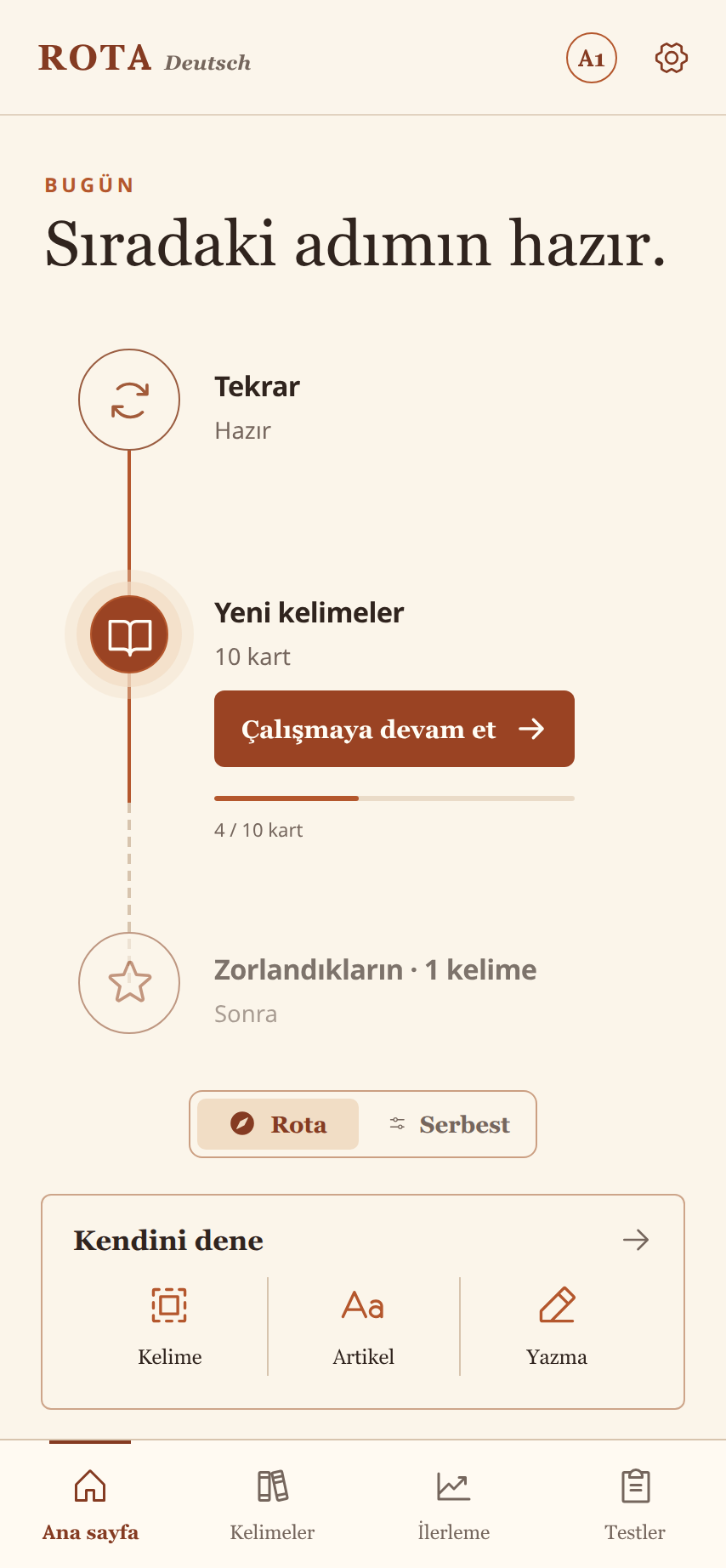
ROTA Recall is a memory-first vocabulary learning product.
It helps learners turn words they have studied into vocabulary they can retrieve while speaking, writing, and thinking—not just recognize when the answer is already in front of them.
The gap between seeing and knowing
Language learners rarely lack words to study.
They encounter vocabulary in courses, apps, videos, and word lists. Yet many of those words remain unavailable at the moment they are needed.
A word may look familiar on a screen and still be impossible to produce independently.
More exposure does not automatically close this gap.
Recall has to be trained.
The answer is already in front of you.
The word is available from memory.
Built for retrieval
ROTA Recall gives every word a structured path into memory.
The product combines active recall and spaced repetition with richer memory cues: pronunciation, imagery, contextual use, meaningful associations, and personalized review.
Every interaction serves the same purpose: make the word easier to retrieve next time.- 01
Understand
Meet the word through its meaning, pronunciation, and useful context.
- 02
Anchor
Connect the word to memorable visual, contextual, auditory, or associative cues.
- 03
Recall
Attempt to produce the word before seeing the answer.
- 04
Reinforce
Revisit it through spaced practice instead of arbitrary repetition.
- 05
Adapt
Direct more attention toward words that remain difficult to retrieve.
Different learners remember differently. ROTA Recall is being designed to support multiple memory anchors rather than relying on a single static card.
More than spaced repetition
Active recall and spaced repetition are proven foundations for memory practice.
But scheduling the next review is only part of the problem.
ROTA Recall is also focused on how the word is encoded in memory in the first place.
Instead of treating every vocabulary item as the same text-and-answer card, the product is being built around richer memory anchors that can connect a word with imagery, sound, context, and meaningful associations.
The long-term goal is to help each learner discover which memory cues make a particular word easiest to retrieve.
A vocabulary product—not a general language course
ROTA Recall is not trying to teach an entire language.
It focuses deeply on a specific and persistent problem:
vocabulary that learners recognize but cannot actively use.That focus shapes the product:
- Recall before recognition
- Retention before content volume
- Context instead of isolated memorization
- Multiple memory anchors instead of repetition alone
- Practice shaped by learner performance
Progress is not defined by how many words have appeared on a screen. It is defined by how reliably learned words can be brought back from memory.
German first
ROTA Recall begins with German vocabulary.
Starting with one language allows us to build and test the complete learning loop with focus: how words are introduced, how memory anchors are presented, how recall is prompted, and how review is scheduled.
German is the starting point, not the limit.
The underlying learning system is being designed so that the same memory-first approach can later support additional languages.
A working product in an early validation stage
Working MVP
The core vocabulary learning and review experience is functional.
Structured validation
Testing the product with German learners, studying recall behaviour, improving the learning experience, and establishing meaningful baseline metrics.
We are not presenting unverified outcomes as proof.
We are building the product needed to measure them.
What we are building next
As usage grows, the system is intended to become increasingly precise about what each learner is likely to forget and what kind of practice can help them retrieve it again.
- 01
Structured MVP testing
- 02
Measurement of delayed recall and review effectiveness
- 03
Expansion of visual and associative memory anchors
- 04
More personalized review timing
- 05
Adaptation to different memory-cue preferences
- 06
Stronger learning-data and content infrastructure
- 07
Expansion to additional languages after validating the German experience
A focused path to a scalable product
ROTA Recall is being developed as a subscription product for individual vocabulary learners.
The initial focus is deliberately narrow:
build the strongest possible system for learning and recalling vocabulary.Once the core learning loop has been validated with German learners, the same underlying memory system can be extended to additional languages and larger vocabulary libraries.
We want to build the memory layer for vocabulary learning.
A system that understands what a learner can actually retrieve—not only what they have opened, viewed, or completed—and uses that understanding to make practice more relevant.
Over time, ROTA Recall aims to move beyond static flashcards toward adaptive vocabulary experiences that combine review timing with the memory cues that work best for each learner.
Help shape a better way to remember words.
ROTA Recall is preparing for early product testing with German learners.
Interested in testing the MVP or following the product as it develops?
Request early access